
Alberta Youth Employment (AYE) Incentive Announced

September 11, 2025 - The Alberta Government today announced a new incentive program to help combat youth unemployment in Alberta. This partnership with Careers the Next Generation (a non-profit who will administer the funding) aims to create new youth focused roles in small businesses to ensure youth have a great start to their working careers.  For many, their first job is the one that teaches lessons of responsibility and consciousness.  The horticultural industry has a long history working with young people and teaching lessons for life (and love of plants and people).   In fact, the announcement was made at long-time member garden centre and landscape firm, Classic Landscape (Ellerslie Gift and Gardens) right here in Edmonton.  Our friend Perry Stothart spoke after the Premiere and Minister regarding the positive impacts a first job in horticultural has had on hundreds and hundreds of youth over the years.  (Way to go Perry and the Payne family!)
Program Overview for Eligible Businesses
The Alberta Youth Employment Incentive program provides financial assistance to registered for-profit businesses to hire young Albertans aged 16 to 24. This program is an excellent opportunity for small businesses to expand their workforce while significantly reducing hiring costs.
The funding structure is tiered based on the number of youth hired and the total hours they work:
A key benefit for businesses with multiple locations is that they can apply for the maximum funding for each location.
How Landscape, Greenhouse, and Horticultural Businesses Can Best Take Advantage
Businesses in these sectors are perfectly positioned to benefit from this program because they are registered for-profit businesses that are operational in Alberta. The seasonal nature of the work often requires a flexible and expanding workforce, making young, energetic talent an ideal fit.
To maximize the benefits, these businesses should:
Suggested Job Roles for Youth
The program highlights the benefits of youth employment, including their tech savviness, energy, and adaptability. Small businesses can leverage these qualities by creating entry-level and hands-on roles that also incorporate modern tools and systems.
In the landscape and horticultural industries, suitable jobs for youth could include:
For more info please visit - https://ayeincentive.ca/
We expect this program to be highly subscribed and as such are suggesting to apply early, even if the intent is to have positions start in 2026.
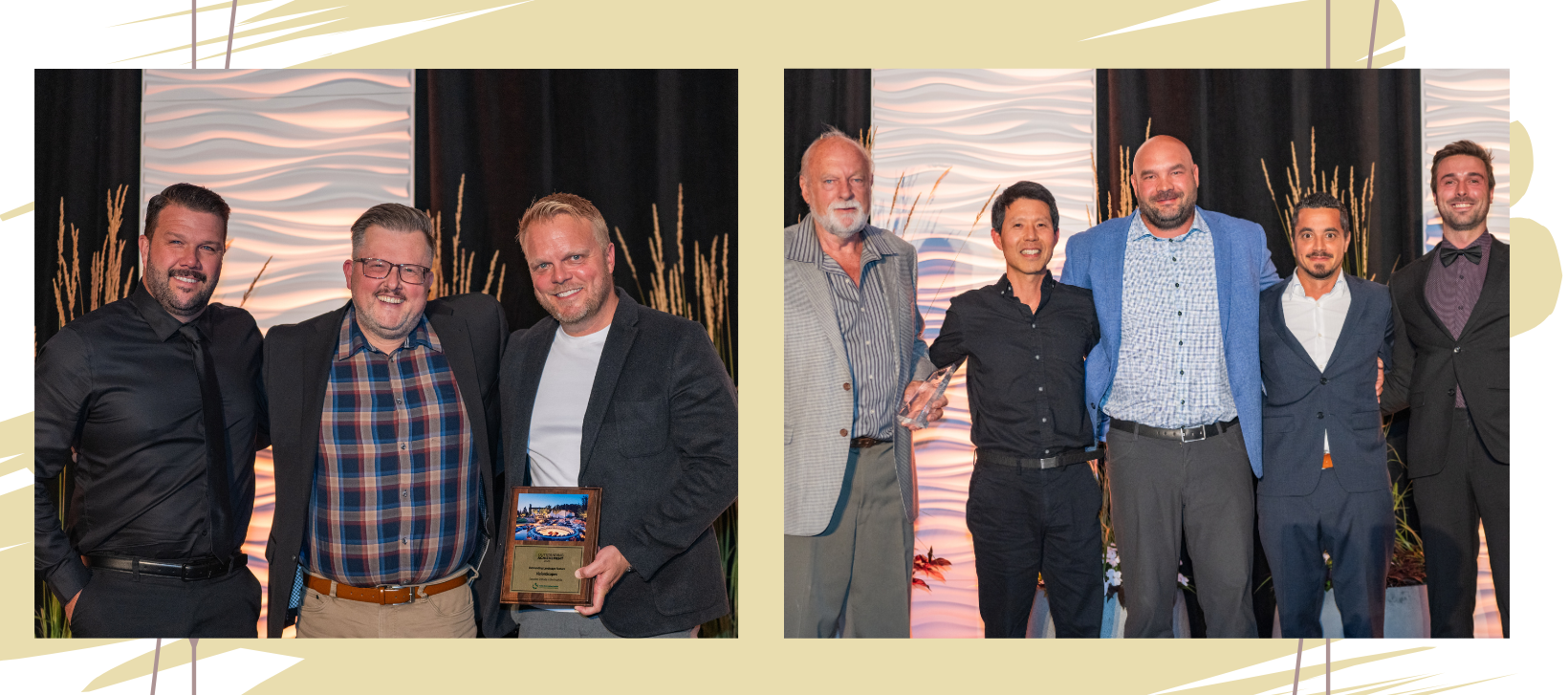

National Award winners announced at gala in Regina, Saskatchewan

August 13, Regina, SK — The 22nd annual National Awards of Landscape Excellence (NALE) winners were announced live on August 12, 2025, during a special gala at Delta Hotels Regina in Saskatchewan. The event welcomed over 100 industry members from across the country, representing a broad cross-section of the horticultural trades.

This year, two Alberta companies received a National Award. Congratulations to Land Tec Landscape Contractors and Visionscapes! And a shout out to all of the other winners for their exceptional contributions to advancing professionalism in the landscape industry!

Home Depot Award for Commercial Landscape Maintenance
Winner: Land Tec Landscape Contractors
For: Uline Edmonton
Location: Edmonton, Alberta

Outstanding Achievement Award for Landscape Feature
Winner: VisionScapes
For: Creating an innovative landscape that includes a river flowing throughout VisionScapes’ Exquisite Solitude in the Foothills project, leading to a fire pit and seating area surrounded by a moat.
Location: Calgary, Alberta

The National Awards of Landscape Excellence (NALE) celebrate Canadian companies that have made significant strides in raising professionalism within the landscape industry. Each province nominates members from their Provincial Awards of Excellence, who then compete at the national level. Provinces can enter up to three submissions per category, comprising fifteen entries per association, in five categories: commercial landscape construction, residential landscape construction, commercial landscape maintenance, residential landscape maintenance, and landscape design.

The top projects in each of the five categories were awarded the Circle of Excellence. Three Outstanding Achievement awards were given to companies whose projects best exemplified green innovation, use of plants, and landscape features.  Additional recognitions include the Green My City award, the Communities in Bloom award of distinction, and the Green for Life Community award.

Caterpillar Award for Commercial Landscape Construction, Rutherford Contracting, Innisfil, ON

Caterpillar Award for Residential Landscape Construction, Swick’s Landscaping, Vancouver, BC

Intrigue Media Award for Landscape Design, Lavish Gardens, Stirling, ON

HortProtect Award for Residential Landscape Maintenance, The Landmark Group, Thornbury, ON

Outstanding Achievement Award for Green Innovation, Clintar of London, London, ON

Outstanding Achievement Award for Use of Plants, Swick’s Landscaping, Vancouver, BC

Caterpillar Green for Life Community Award, Summerside and Area Garden Club, Summerside, PEI

Green My City Award, Brookmill Blvd. Jr. Public School, Toronto District School Board

Communities in Bloom Award of Distinction, Ville de  Rosemère

2025 Nursery Producers Auction Donation Form

Landscape Alberta Nursery Producers Auction Donation Form 2025

Name(Required)
Mail to Landscape Alberta Nursery Producers Group, 18051 107 Ave NW, Edmonton, AB T5S 1K3. Cheques payable to Landscape Alberta.
Drop-Off Donation
Pick-Up Donation
Please upload photo(s) of your donation(s) AND your company logo.
Drop files here or
Max. file size: 614 MB.

    Check your elm trees for DED symptoms – Elm Submission Form

    Dutch elm disease is becoming more of a concern in Alberta.  2025 Edmonton has had one elm tested positive for DED.  Elm surveys are being done throughout the city all season. It only takes one piece of DED infected elm wood to cause a problem.

    If you see signs of DED in your elm tree – wilting leaves in summer, branch dieback, brown streaks under the bark, please contact the hotline number in your municipality or the STOPDED hotline.

    https://www.alberta.ca/dutch-elm-disease-overview


    Dutch elm disease (DED) Hot line numbers

    • City of Airdrie 403-200-2699
    • City of Beaumont 780-929-4300
    • City of Brooks - 403-501-8793
    • City of Calgary - 311
    • City of Camrose - 780-672 9195
    • City of Chestermere – 403-207-2807
    • City of Edmonton - 311
    • City of Fort Saskatchewan- 780-722-9739
    • City of Lacombe - 403-782-1297
    • City of Leduc – 780-980-7133
    • City of Lethbridge - 311
    • City of Lloydminster 780-205-4600
    • City of Medicine Hat – 403-529-8333  “Option 6”
    • City of Grande Prairie- 311
    • City of Red Deer – 403-342-8238
    • City of Spruce Grove - 780-962-7584
    • City of St. Albert – 780-459-1557
    • Town of Stony Plain – 780-963-2469
    • Strathcona County - 780-467-2211
    • STOPDED – 1-877-837-ELMS (3567)

    Emerald ash borer

    • CFIA @ 1-800-442-2342
    • STOPDED – 1-877-837-ELMS (3567)


    All elm trees showing DED symptoms must be tested in the lab using the following form.

    https://www.alberta.ca/dutch-elm-disease-sampling-procedures

    https://www.alberta.ca/system/files/custom_downloaded_images/af-aphl-lab-sample-submission-form.pdf

    Samples must be sent to the lab by a Municipality, County, MD or Special Areas representative.

    City addressing sixth case of Dutch elm disease confirmed in Edmonton

    July 17, 2025

    The City of Edmonton has confirmed an elm tree in the Alberta Avenue neighborhood has tested positive for Dutch elm disease (DED). This is the sixth tree confirmed to have Dutch elm disease since it was first discovered in Edmonton in August 2024.

    The infected tree is located along the boulevard. It, as well as elm trees within 20 metres of the infected tree, will be removed promptly as part of ongoing efforts to contain the spread of the deadly fungal disease. Extensive additional testing of trees in the vicinity is underway.

    “City arborists, urban foresters and the pest management team remain vigilant as we continue implementing the established Dutch elm disease management plan, including intensified surveillance of elm trees. This additional confirmed case does not change our approach as we continue assessments, removals and testing in coordination with the province and the Canadian Food Inspection Agency,” said Mark Beare, Director of Infrastructure Operations. “While any positive test is disappointing, we remain confident that this collaborative approach is helping to limit the spread of the disease.”

    Prompt removal of infected trees, and elm trees in the immediate vicinity, is essential for the health and safety of Edmonton's urban forest, as elm trees constitute 22 per cent of our Open Space and Boulevard Tree Inventory, totaling approximately 90,000 elm trees. Dutch elm disease is a contagious fungal infection that poses a major risk to other elm trees in the vicinity. An ongoing diligent pruning program to remove the deadwood in elms is necessary to reduce the habitat of the beetles which may spread the fungus.

    Disposal of all removed elms occurs at the Edmonton Waste Management Centre in accordance with special handling procedures. Enhanced monitoring and assessments of trees in a one-kilometre radius of the infected trees are in place.

    The previous five positive cases of Dutch elm disease were located in the Killarney and Yellowhead Corridor East neighbourhoods. The sixth tree was identified as presenting signs of the disease by City crews while conducting a planned visual assessment of trees in the Alberta Avenue neighbourhood. Staff with the City’s Integrated Pest Management Lab submitted samples from the tree to the provincial lab for testing. A positive result was received from the Government of Alberta on July 16, 2025.

    What residents can do

    Containing the spread of Dutch elm disease is a community effort. There are three ways residents can help stop the spread of the disease:

    1. Do not bring firewood from another jurisdiction.

    ○ Beetles that carry Dutch elm disease are most likely to be brought to Edmonton in firewood, so remember to always “burn it where you buy it.”

    2. Remove bark beetle habitat.

    ○ Prune elm trees between October and March to remove dead, dying and diseased branches (video).

    ○ Provincial law and municipal bylaw require elm tree owners to prune dead and dying branches from October through March.

    ○ All elm wood must be disposed of immediately by burning, burying, chipping or disposal at the Edmonton Waste Management Centre.

    ○ Do not combine elm wood with food scraps or other collected waste.

    3. If you see signs of Dutch elm disease, call 311.

    Signs of Dutch elm disease:

    ○ Brown staining in the sapwood that can be seen by removing the bark of infected twigs.

    ○ From the latter half of June to the middle of July, the leaves on one or more branches may wilt, droop and curl. The leaves then turn brown and usually remain on the tree.

    ○ If the tree is infected later in the summer, the leaves will droop, turn yellow and drop prematurely. Late season infections are easily confused with normal seasonal changes.

    ○ Beetle emergence holes, the size of the diameter of a pencil lead, and/or sawdust on the bark, indicate burrowing beetles.

    For more information: edmonton.ca/dutchelm

    If you see signs of DED in other parts of the province, call the STOPDED hotline 1-877-837-ELMS (3567)

    TFWP – Extension and end of temporary suspension of the minimum advertising requirements in Primary Agriculture

    Effective January 1, 2026, the Government of Canada will reinstate the requirement for employers to provide proof of advertising when submitting a Labour Market Impact Assessment (LMIA) application to hire temporary foreign workers for primary agriculture positions under the Temporary Foreign Worker Program (TFW Program).

    To ensure a transition, the temporary suspension of the minimum advertising requirements for positions in primary agriculture will be extended beyond June 30, 2025, until December 31, 2025. This means that employers are not required to provide proof of advertisement with their LMIA application submitted up to December 31, 2025.

    Employers are expected to continue efforts to recruit Canadians and permanent residents, including members of underrepresented groups in the labour market, such as:

    • vulnerable youth,
    • Indigenous peoples,
    • newcomers to Canada,
    • persons with disabilities, and
    • asylum seekers with valid work permits.

    For inspection purposes, employers must continue to retain records that document evidence of their recruitment efforts.

    You are encouraged to share this communication throughout your respective networks, and with any colleagues or peers who may need to be aware of this information. If you have questions on the TFW Program, please visit Canada.ca or reach out to the Employer Contact Centre


    Acelepryn Minor Use Label Expansion for Box Tree Moth

    PMRA has just accepted the registration of Acelepryn (a.i. chlorantraniliprole) on outdoor grown boxwood plants for control of Box Tree Moth (BTM) in Canada.

    Please see the linked updated labels below. The labels on the Health Canada Label search app should be updated on the PMRA label search website sometime in the next few weeks; until then, the attached labels may be used for grower applications should they wish to make applications.

    Please note, if making the drench application for control of Japanese Beetle larvae, the low rate will need to be used to ensure the maximum amount of active ingredient permitted per hectare per season is not exceeded. A notification article will be posted on the ONnursery blog in the coming days / weeks.

    Calgary – Watering Schedule

    (originally shared by CPCIA)

    City of Calgary presented updates on the Preferred Watering Days initiative and Water Managed Sites Program. These proactive measures aim to help manage the City's water system load while critical infrastructure repairs and upgrades continue.

    While essential repairs to the feeder main have been completed, the City is not yet operating the line at full capacity. Until major infrastructure projects are finalized, there remains an increased risk that Stage 1 Outdoor Water Restrictions could be called if water demand exceeds system capacity.

    As we enter the spring and summer seasons — our busiest period for irrigation — it’s vital that our industry leads by example. By working together, we can help reduce system strain and minimize the likelihood of formal restrictions being imposed. 

    Why Water Conservation Matters Now, Reducing watering especially important when:

    • Water treatment or distribution infrastructure is under repair or upgrade;
    • Hot weather drives high demand that strains water treatment capacity;
    • River levels are lower than normal due to drought;
    • River water quality fluctuates.

    Action Requested: Adopt Preferred Watering Days

    To assist the City and protect the health of our landscapes, all irrigation professionals are asked to configure systems to follow the City’s Preferred Watering Days.

    This is not a bylaw change — it is a voluntary industry effort to help balance demand and protect our ability to operate without restrictions.

    Preferred Watering Days:

    • Odd-Numbered Addresses: Wednesday, Friday, Sunday
    • Even-Numbered Addresses: Tuesday, Thursday, Saturday

    By adjusting irrigation schedules accordingly during spring system start-ups, we can help the City's reservoirs replenish adequately during periods of peak use.

    About Water Managed Sites (WMS)

    A Water Managed Site (WMS) designation certifies that an irrigation system can adjust watering based on actual site needs — either by weather conditions or soil moisture levels — to maintain landscape health efficiently.

    Certified WMS sites are permitted greater flexibility under Stage 1 Outdoor Water Restrictions (Schedule E).

    Becoming a WMS ensures:

    • Healthier landscapes during periods of water shortage.
    • Protection of client properties.
    • Continued leadership by our industry in responsible water use.

    For more information about Water Managed Site certification, please visit: Water Managed Sites

    TFWP + Public Health information

    Due to outbreaks of measles in Canada and in other countries, here are some reminders for employers and temporary foreign workers (workers) participating in the Temporary Foreign Worker Program (TFW Program).

    Stay informed and follow the recommendations of  the appropriate public health authorities

    Measles is an extremely contagious disease caused by a virus. The Public Health Agency of Canada is working closely with provincial, territorial and international partners to share information and monitor the situation in Canada and globally.

    Employers and workers can learn about measles and the preventive measures that can be adopted by consulting:

    Employers and workers can refer to weekly surveillance reports to keep track of the current status in Canada, at a national level, and in their region of work.

    As the situation evolves, public health recommendations may change. Employers and workers are recommended to regularly check the website of the public health authority in their province or territory to obtain updates and information on the preventive measures in place, particularly the availability of measles vaccination in their region:

    Reminders regarding the responsibilities of employers and workers participating in the TFW Program

    • On or before the beginning of the employment period, the employer must provide workers with the most recent version of the document: Temporary foreign workers: Your rights are protected - Canada.ca. The employer must also ensure that this information remains accessible to the workers throughout the duration of their employment.
    • Workers are entitled to free healthcare under the health insurance system of the province or territory where they work. In case of delays upon their arrival or for any other period during which the workers are not covered, the employer must obtain and pay, without deductions from the worker’s salary, for a private health insurance covering emergency medical care until the workers are covered by the provincial or territorial plan. For workers under the Seasonal Agricultural Worker Program (SAWP) stream, the employer should ensure to follow requirements provided in the SAWP contracts.
    • As the most effective way to protect oneself against measles is through vaccination, workers are encouraged to review their immunization history, including for measles, before coming to work in Canada. The employer should also make reasonable efforts to support workers who wish to voluntarily get vaccinated in Canada.
    • In the event of an outbreak of communicable diseases, such as measles, the employer must work with the appropriate provincial or territorial public health authority to establish clear protocols to mitigate disease spread and maintain transparent communication with employees and the public health authority. Both the employer and the workers must follow the guidelines issued by public health. This includes recommendations regarding isolation for a specified period, including when housing is provided by the employer.
    • If a worker is sick or shows symptoms of measles, they must inform their employer as soon as possible, isolate at home and call a health care provider immediately for advice. If the worker needs to leave isolation to seek medical care, it is essential to inform the facility before arriving, that the worker may have measles to allow for appropriate precautions to prevent the spread of virus to others. The employer must make reasonable efforts to ensure that workers have access to healthcare services and professionals, such as a doctor, nurse, or pharmacist.

    In order to maintain a safe working environment, it is essential for employers and temporary foreign workers to be aware of available preventive measures to reduce the transmission of measles, especially given the resurgence of cases.

    You are encouraged to share this communication throughout your respective networks, and with any colleagues or partners who may need to be aware of this information.

    If you have questions about measles, please consult:

    *Please note that a Spanish version of the information sheet is linked here: Measles Factsheet_SPA

    If you have questions on the TFW Program, please visit Canada.ca or reach out to the Employer Contact Centre.

    Thank you for your continued collaboration.

    The Temporary Foreign Worker Program

    Employment and Social Development Canada