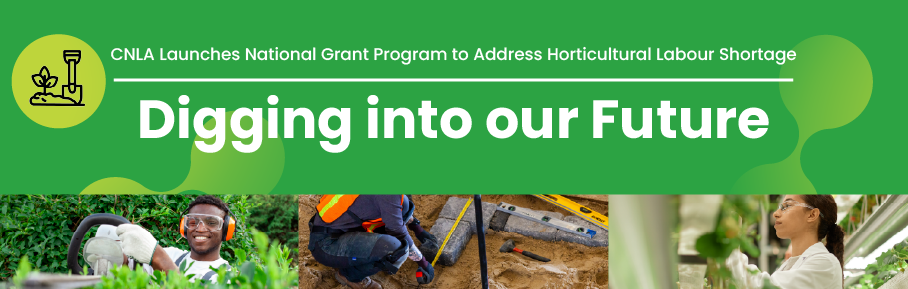
Canadian Nursery Landscape Association Launches National Grant Program to Address Horticultural Labour Shortage

Digging into our Future

New national program supports workforce entry, retention, and long-term industry growth.

Milton, Ontario - The CNLA is launching Digging into our Future, a new national employee grant program designed to support the attraction and retention of new employees in the horticulture and landscape industry.

The program will provide 10 grants of $1,000 each to eligible new entrants working in qualifying horticulture and landscape roles across Canada. The grant is paid directly to the employee in two stages: $500 upon entry into a qualifying position and $500 after four months of continuous employment with the same employer.

Digging into our Future is intended to reduce barriers to entry, support employment continuity, and help strengthen the horticulture workforce by encouraging new people to build lasting careers in the industry.

“Labour remains one of the most pressing issues facing our sector,” said Jeff Foley, HR Chair, Canadian Nursery Landscape Association (CNLA). “This program is designed to support new entrants directly by helping reduce barriers at the start of employment and encouraging retention in the months that follow. It is a practical way to support people entering the industry and help strengthen the workforce over the long term.”

To be eligible, employees must be newly entering the horticulture or landscape industry, be legally eligible to work in Canada, work in a horticulture-related role, work a minimum of 35 hours per week, and not be an immediate family member of the employer. Grant payments will be issued only to the eligible employee, subject to program requirements and verification.

Eligible employers must operate within the horticulture or landscape sector, be members of a Provincial Nursery Landscape Association, comply with employment standards, remain in good standing with no outstanding violations, and agree to program verification and reporting requirements. Only one application per company will be accepted.

Applications must be submitted within 30 days of hire and must include proof of employment, an employer verification form, and an employee declaration. To receive the second payment, the employer must confirm that the employee has completed four consecutive months of employment with the same employer.

Applications will be reviewed based on eligibility, submission completeness, and funding availability. CNLA may audit applications and conduct random verification checks. False or misleading information may result in repayment of funds and disqualification from the program.

For more information about Digging into our Future, including eligibility details and the application form, visit www.cnla.ca/grants

About CNLA
The Canadian Nursery Landscape Association (CNLA) is a national federation of provincial associations representing members in the landscape, garden centre, and nursery sectors across Canada. CNLA works to support a strong, professional, and sustainable ornamental horticulture industry through advocacy, education, and workforce development. Learn more at www.cnla.ca/grants  

Update Advertising Requirements for TFWP

Update Advertising Requirements for TFWP

New Recruitment Requirements for Low‑Wage Positions (Effective April 1, 2026)

To continue protecting the Canadian labour market and reinforce the priority hiring of Canadians and permanent residents, the TFW Program is introducing two new recruitment requirements for low‑wage positions.

These requirements apply to Labour Market Impact Assessment (LMIA) applications received on or after April 1, 2026.

Employers must:

  1. Advertise the position for at least 8 consecutive weeks
    • Advertising must take place within the 3 months prior to submitting an LMIA application.
    • The full advertising period must be completed before the LMIA is submitted.
  2. Demonstrate targeted recruitment efforts to reach youth (ages 15–30)
    • Employers must show that reasonable efforts were made to encourage youth to apply and be hired before seeking a temporary foreign worker. This can include posting on Job Bank (youth section) and youth job boards, working with schools or colleges, participating in youth employment programs, or using other platforms commonly used by youth.
    • These youth‑focused efforts are in addition to, and do not replace, existing recruitment requirements.

 General Recruitment Requirements – Key Reminders

Before hiring a temporary foreign worker, employers must make reasonable efforts to hire or train Canadians and permanent residents.

For positions in the High-wage Stream or Low-wage Stream, employers must conduct at least 3 recruitment activities to select qualified Canadians and permanent residents.

Employers must review and consider all applications received from Canadians and permanent residents, regardless of whether they are submitted through Job Bank or other recruitment methods used for the position.

Employers are required to retain recruitment and advertising records for a minimum of 6 years and may be requested by Service Canada as part of LMIA assessments or compliance activities. In Quebec, eligible employers for the traitement simplifié must keep recruitment and advertising records even if they are not required to submit these documents at the time of submission.

All required advertising must be completed within the 3-month period before submitting an LMIA, with at least one recruitment activity ongoing until a positive or negative LMIA decision is issued.

The job offer should be consistent with the reasonable workforce needs of the business, and the content in the advertisement should be in line with the position being sought through the TFW Program.

Employers in Quebec, wishing to hire temporary foreign workers, must also consult the MIFI website for provincial requirements.

Please note that there are variations to the requirements on recruitment and advertisement, particularly for primary agriculture positions using the streams for high-wage or low-wage positions.

Mandatory Use of Job Bank: Job Match and Direct Apply

When using Job Bank, employers must ensure that both Job Match (except for primary agriculture positions) and Direct Apply features are enabled and used.

Within the Job Bank employer account:

  • Canadian citizens/permanent residents are identified by a red maple leaf
  • Temporary residents are identified by a character icon

The TFW Program monitors activity on Job Bank to ensure that requirements are met. Disabling Job Match or Direct Apply or failing to consider qualified Canadian or permanent resident applicants may result in a negative LMIA decision.

Additional information

You may consult the TFW Program website for more information on variations to the minimum recruitment and advertising requirements, including primary agriculture positions using the streams for high-wage and/or low-wage positions.

To learn more about the TFW Program, visit Canada.ca or reach out to the Employer Contact Centre.

Job Postings Spring 2026

YESP – Now accepting applications

As of March 5, 2026, you may access documents for the 2026-27 program year and submit your application. Applications will be accepted until May 4, 2026 (at 11:59 p.m. Pacific Time).

The YESP provides non-repayable contributions to employers who hire youth aged 15 to 30 and provide meaningful work experience in the agriculture and agri-food sector. The YESP covers 50% of wages and benefits paid to a youth (or 80% for Indigenous employers and/or employers who hire a youth facing barriers to employment), up to $14,000, with up to an additional $5,000 available to support relocation or barrier-related costs.

Before you apply, please ensure you read through the program guidelines on AAFC’s website. The program guidelines provide detailed information on eligibility criteria, how to apply, and changes in 2026-27, including changes to: application limits and requirements (such as identifying the youth participant in your application), the eligibility of previous youth participants, and eligible costs for relocation and addressing barriers to employment. 

To apply, download and complete the Project Application Form and Participant Information Form from our website, and submit your application and any supporting documents.

For any questions, email aafc.yesp-pecj.aac@agr.gc.ca or call 1-866-452-5558.

YESP 2026-2027 - EN

TFW Program – Information on Primary Agriculture Sector / Seasonal Agricultural Worker Program

Starting January 2nd, the wage rate for Nursery, sod and greenhouse workers in Alberta has increased to $17.98 per hour (from $17.44) as part of the annual 3.12 increase set to the consume price index.  Other changes and updates are below.

Primary Agriculture

Subject to certain criteria, four streams are available to employers to hire temporary foreign workers in the Primary agriculture sector.

Employers should regularly consult the TFW Program’s website to ensure that they are fully aware of and updated on their compliance obligations and the requirements applicable for each stream:

Prevailing wages in the SAWP and the Agricultural streams

Employers must provide temporary foreign workers with the same wages and benefits as those provided to Canadian and permanent resident workers in the same occupation.

At all times during the employment period, employers are responsible for adjusting the worker’s wage to ensure that it meets or exceeds the applicable federal/provincial/territorial minimum wage rates in effect or the National Commodity List (NCL) tables rates, whichever is higher.

The next update to the NCL wage tables is scheduled for January 2, 2025. This update will include adjustments based on the Consumer Price Index. Accordingly, wages will increase by 3.12% unless the federal/provincial/territorial minimum wage is higher.

Throughout the year 2025, based on federal/provincial/territorial changes to minimum wage, other updates will be made to the NCL tables. The TFW Program website will be continually updated to reflect these changes, and employers are encouraged to consult it regularly.

SAWP contract for 2025

The TFW Program SAWP Stream has a standard, non-modifiable contract that is reviewed annually. The SAWP contract doesn’t need to be included with the employer’s Labour Market Impact Assessment (LMIA) application. However, employers are required to keep a copy of the contract signed by both the employer and the worker on file in the event of an inspection. Workers must sign the copy of this contract on or before the first day of work, and employers must provide copies of the contract to the workers in English or French, and Spanish (when applicable). The SAWP contract for 2025 will be available on the TFW Program’s website in early January.

Temporary suspension of the minimum advertising requirements

As of January 12, 2022, and until June 30, 2025, minimum advertising requirements are suspended for employers applying for a LMIA to hire temporary foreign workers for primary agricultural positions.

This means that employers are not required to submit proof of advertisement with their LMIA application; however, they are expected to continue efforts to recruit Canadians and permanent residents, including members of groups who are under-represented in the labour market, such as:

  • vulnerable youth,
  • Indigenous peoples,
  • newcomers to Canada,
  • persons with disabilities, and
  • asylum seekers with valid work permits.

For inspection purposes, employers must continue to retain records that document evidence of their recruitment efforts.

CNLA 2024 Wage Survey

Boost Your Business with Wage Survey Data: A Game-Changer for Landscapers, Nurseries, and Garden Centres 

In today's competitive market, small businesses in the landscaping, nursery, and garden centre industries face unique challenges in attracting and retaining skilled employees. One powerful tool that can give you an edge is wage survey data. Understanding industry-specific wages in your geographic area not only helps you stay competitive but also enhances your hiring and retention strategies. 

Industry-Specific Insights
For landscapers, nurseries, and garden centres, wage survey data provides a clear picture of prevailing wage rates within your specific industry. This information allows you to offer competitive salaries that attract top talent. Whether you're hiring seasonal workers, experienced horticulturists, or equipment operators, knowing the standard wage rates helps you make informed decisions that align with industry norms. 

Geographic Relevance
Wage survey data is invaluable because it considers the geographic specifics of your business location. Pay rates can vary significantly from one region to another due to differences in the cost of living and local market conditions. By accessing localized wage data, you can ensure that your compensation packages are attractive and fair for your region. This not only helps in attracting local talent but also in making your business a desirable place to work. 

Benefits to Hiring 

  1. Competitive Offers: By leveraging wage survey data, you can craft competitive job offers that stand out to potential employees. When candidates see that your compensation aligns with or exceeds industry standards, they are more likely to choose your business over others. 
  1. Attracting Talent: Offering competitive wages helps you attract a diverse pool of skilled candidates. This is especially crucial in the landscaping, nursery, and garden centre industries where specialized skills and knowledge are essential. 

Benefits to Retention 

  1. Employee Satisfaction: Fair and competitive wages contribute to higher employee satisfaction. When your staff feels valued and fairly compensated, they are more likely to stay loyal to your business, reducing turnover rates. 
  1. Enhanced Productivity: Satisfied employees are generally more motivated and productive. By using wage survey data to offer competitive salaries, you create a positive work environment where employees are committed to delivering their best performance. 
  1. Long-Term Growth: Retaining skilled workers ensures that your business can maintain high standards of service and productivity. Experienced employees bring valuable knowledge and expertise, contributing to the long-term growth and success of your business. 

All participants in the 2024 CNLA Wage Survey have been automatically sent digital access to the full survey report.  Members that did not particpate that require a copy can do so for the preferred rate of $50, while non-members will pay $75.  For more details or to order your copy of the wage survey please visit www.wagesurvey.ca. 

Make the smart choice today and leverage wage survey data to boost your hiring and retention strategies! 🌱🌼🪴